
The Devil Wears Prada 2 Is a Fantasy for Everyone Who Still Loves the Work
And are you really a millennial journalist if you’ve never gotten laid off?

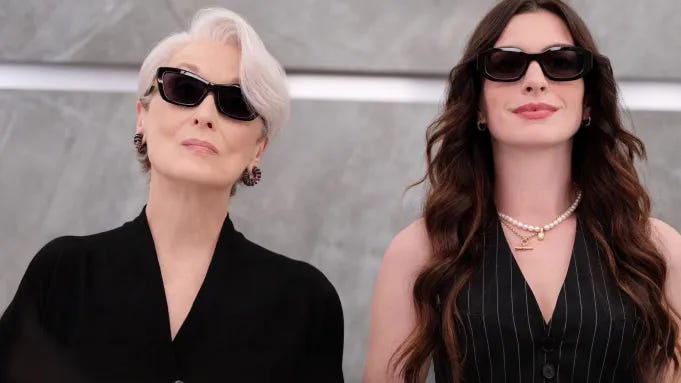
In my professional writing career, I’ve gotten laid off five times. I’ve quit four times. I’ve had my contract abruptly cut so many times that, much like my body count, I eventually decided it was more spiritually elegant to stop keeping track. We don’t need to get into the amount of times I’ve been fired. Okay, twice. And one of those times was for telling my boss they lacked taste, which I still do not regret because, unfortunately for them, I was right.
What defines a professional writing career? Depending on the day, I’ll tell you it’s the first time you publish something. On others, like today, the morning after watching The Devil Wears Prada 2 instead of attending Met Gala afters because I am at peace with being chic in an AMC recliner, I’ll tell you it’s the first time someone pays you for your writing.
The first time I was ever paid for my writing was $1 for a Tumblr post on an account aspiring to become a zine for queer people. The editor of that Tumblr account is now a very notable editor at a reputable publication and, from what I can tell, doing quite well. To be honest, the dollar meant nothing to me. It was the byline. To have something literally labeled as yours. To see your name under the thing your brain made. That was the drug.
At the time, ghostwriting was something I mostly understood because of Drake lyrics. I did not yet understand that so much of professional writing would involve sitting in conference rooms, Slack threads, Google Docs, Figma files, and emotionally hostile brainstorms while watching people with better titles and worse sentences slap their names across the work you researched, shaped, rewrote, legally signed away, and were then told you could never publicly claim because it now belonged to the company.
Which is such a funny phrase. “Belonged to the company.” Like the company stayed up until 2:00 AM trying to make a sentence sound less like it was written by a LinkedIn thought leader having a gas leak.
This is the emotional trap of being a writer in the modern economy. You are constantly being asked to prove the value of something everyone consumes and almost no one wants to pay for. Everyone wants the words. The idea. The voice. The angle. The polish. The cultural fluency. The thing that makes people feel something. But the second it is time to pay the person who made it, suddenly the budget is tight, the brand is pivoting, the team is restructuring, and your role has been “impacted.”
Impacted. What a gorgeous corporate word. It sounds so gentle. Like getting laid off is something that happens to you at a spa.
So when I say The Devil Wears Prada 2 felt like a love letter to millennial journalists, I don’t mean that as a neutral compliment. I mean it in the way a cigarette after a panic attack feels romantic. I mean it in the way you can hate an industry and still feel your whole body light up when someone says, “We need a writer.”
The movie is not great in the way cinephiles on Letterboxd talk about movies being great. It is not trying to be Tár in Chanel. It is cheesy. It is glossy. It has lines so on-the-nose they should come with rhinoplasty. There are moments where you can feel the studio executives hovering over the script like, “Can we make this more iconic?” which is always how you know something is about to become deeply embarrassing.
And yet, I loved it.
The movie begins with Andy Sachs getting laid off from her newspaper job, which is almost too on the nose. I laughed because I am brave. Here she is, 20 years after surviving Miranda Priestly, now an award-winning journalist with the kind of career the first movie told us she wanted. She did the thing. She got out. She became serious. She got the certificates, the clippings, the respectability, the apartment walls covered in proof.
And then the paper…folds anyway.
That is the part that makes this sequel more interesting than its own campy packaging suggests. The original Devil Wears Prada gave millennials one of our foundational career myths: take the humiliating job, learn the game, survive the tyrant, weaponize the proximity, and eventually you will become the person with the office.
Millennials were told that if we worked hard enough, networked correctly, accepted the unpaid internship, ate the sad desk salad, answered emails at midnight, built a personal brand, optimized our LinkedIn, monetized our hobbies, and learned how to say “circle back” without dissociating, we would eventually arrive at stability. I worked seven internships while working retail during my junior and senior year of college and yes, one of them was at Condé. I was not just drinking the Kool-Aid. I was mixing it in the break room.
You may lose your boyfriend, your birthday, your friends, your sense of self, and possibly your ability to identify carbs without flinching, but it will all be worth it because one day, the ladder will hold.
Instead, we got layoffs, rising rent, egg freezing, AI-generated slop, and a job market where a Pulitzer Prize winner and someone with a Canva certification are somehow both in the final round for a Creative Director role.
The Miranda Priestlys of the world are not to blame for this.
Writing for you all is my passion, but coffee and Wi-Fi aren’t free! If you’re enjoying this piece, tossing a few bucks my way helps me keep the lights on (and the caffeine flowing) so I can keep bringing you fun, unfiltered stories like this. Thank you for supporting my little baby independent publication.
The Devil Wears Prada 2 understands something the first movie could only flirt with: the real villain was never Miranda Priestly. Not really. Miranda was terrifying, yes. Abusive, yes. A woman who could turn silence into a performance review, absolutely. But Miranda was also the last recognizable monster of a dying era. She believed in creativity. She believed in standards. She believed in the work so much that she made everyone around her bleed for it.
Was that healthy? No. Was it labor exploitation in a fabulous coat? Yes. Did it still have more integrity than a podcast host with a ring light explaining “the future of journalism” after skimming three TikToks and one Substack headline? Unfortunately, also yes.
That is what makes the sequel sharper than I expected. It brings Andy, Miranda, Nigel, Emily, and Runway into a media landscape where the old tyrants have been replaced by something worse: people with no taste deciding the future of taste, AI with no soul, influencers with no editorial standards, and corporate men who use words like “scale” because they cannot spell “meaning.”
It is too easy, and frankly too shallow in the most white-girl-wellness “rest is an act of resistance” annoying way, to look at The Devil Wears Prada 2 and conclude that its emotional failure is loving work too much. That reading flattens what the movie actually understands. The sequel is not asking us to worship hustle culture. It is asking us to separate the work from the institutions that abused our devotion to it.
That distinction matters.
In DWP2, the fashion magazine and the editorial world in general are no longer the center of cultural power. The sequel knows this. It is practically wearing a sandwich board that says PRINT IS DEAD BUT THE OUTFITS ARE STILL GOOD. Emily has pivoted into luxury retail at Dior, and later Coach, because even the most devoted Runway disciple understood that proximity to taste no longer guarantees proximity to power.
Fashion magazines have become distressed properties. Brand assets. Nostalgia machines. Beautiful corpses with subscriber funnels. The glossy media world that once made Andy Sachs feel like she was selling her soul is now fighting to prove it still has one.
And Andy’s return is what gives the film its ache. In the first movie, she was the idealistic young journalist who looked at Runway as a detour from the “real” writing she wanted to do. She wanted newspapers. Serious journalism. Work that mattered. The kind of job that, in 2006, still felt like an achievable moral destination instead of a haunted escape room with layoffs every fiscal quarter.
Twenty years later, the joke is on everyone. The serious publications are gutted. The magazines are starving. The internet is a casino. AI is writing serviceable sentences for people who think serviceable is good enough. Influencers are “reporting” from their kitchens. Podcasters are mistaking talking for thinking. Everyone is a brand. Everyone is a media company. No one has health insurance.
During their reunion in the cafeteria, Nigel tells Andy that before, if they were doing an exposé, he could get a four-week trip to the Sahara with hair, makeup, interviews, and fabulous dinners. Now, he’s lucky if he gets a two-day shoot at Milk Studios with an influencer promoting something people will scroll past and forget about the second they’re done using the toilet.
And somehow, Andy Sachs is still trying to write.
That is not because Andy failed to grow. It is because the economy did not keep its end of the bargain.
That is the fantasy this movie gives us. Not that journalism can be saved. That may be too deranged even for Disney. The fantasy is that the people who loved the work before it became “content” still have a say in this world. The fantasy is that having a unique point of view still matters. The fantasy is that a woman who has been chewed up by the industry can walk back into the room, older and clearer and probably with a better coat, and still have something to offer besides trauma and a LinkedIn post about resilience.
And maybe this is where I diverge from the more cynical readings of the film. I do not think The Devil Wears Prada 2 is saying the sacrifices were worth it in the old girlboss way. I do not think it is telling us to ruin our lives for a job because one day we, too, might be allowed to terrorize an assistant. The movie is too haunted for that. Too aware of what the last 20 years did to the audience watching it.
It is saying something more complicated and more irritatingly true: sometimes the work is worth loving even when the job is not.
Because that is the part nobody warns you about. You can be exploited by the work and still love the work. You can be underpaid by the work, erased by the work, laid off by the work, humiliated by the work, and still feel most alive when you are doing it well. You can know the industry is collapsing and still care whether the sentence sings. You can resent every institution that profited from your talent and still miss the version of yourself who believed a byline could save you.
The job will betray you. The publication will fold. The editor will leave. The contract will end. The company will announce a “new direction.” The billionaire will decide your department is redundant. The AI tool will produce 800 words of perfectly lifeless copy and some executive will call it “promising.” But the work, the actual work, the act of arranging chaos into meaning, still belongs to you in the most private and annoying way.
So yes, I understand why some people will find The Devil Wears Prada 2 too neat. Too nostalgic. Too forgiving. Too willing to turn the corpse of media into a feel-good reunion special with better tailoring. But I also think that is exactly why it works. It is not a film about how journalism survives. It is a film about why some of us still can’t stop wanting it to.
That is the millennial journalist sickness. We were raised on Nora Ephron, Carrie Bradshaw, Andy Sachs, Jenna Rink, glossy magazines, alt-weeklies, blogs, Tumblr, Gawker, Jezebel, Rookie, The Cut, and the deranged belief that having a voice could become a life. Then we entered the workforce right as the ladder was being pulled up, sold, rebranded, acquired, and replaced with a creator economy course taught by someone who cannot use a semicolon.

And maybe that is embarrassing. Maybe loving work this much, after everything, is its own form of Stockholm syndrome. Maybe every writer is just one invoice away from becoming the Joker in loafers. Loving work has absolutely been used against us. Capitalism looked at millennial passion and said, “Great, we can underpay that.” The phrase “do what you love” has probably done more damage to creative labor than half the layoffs in media.
This is why the movie’s happy ending lands, even when it shouldn’t. I know what it is doing. I can see the machinery. I know I am being emotionally manipulated by a legacy IP sequel designed to make women in their 30s and 40s feel like their ambition wasn’t a scam. And honestly? Fine. Manipulate me. I’ve been manipulated by worse for less. At least this time it’s with Anne Hathaway and Meryl Streep.
The film’s full-circle ending, with Miranda and Andy in the car together, is sentimental in a way the original would have mocked. Miranda is softer now, but not defanged. She is not suddenly warm. God forbid. She is still Miranda. But she has become something more interesting than a villain: a woman who has survived long enough to watch the thing she gave her life to become unrecognizable.
When she looks out the window and says she loves the work, the line should be corny. It is corny. It is also devastating.
Because Miranda does not say she loves being exploited. She says she loves the work.
Craft can be pleasurable. Competence can be pleasurable. Being good at something can be one of the few remaining forms of dignity in an economy determined to make everyone feel disposable. In a culture where every creative act has to justify itself through engagement, conversion, or “personal brand alignment,” there is something almost perverse about watching two women look at each other and admit that the work itself is fun.
Not easy. Not ethical. Not always worth the cost. Fun.
That word is doing a lot. Fun is not hustle. Fun is not productivity. Fun is not self-optimization. Fun is the private thrill of knowing you caught the right detail. The right edit. The right sentence. The right image. The right line break. The right reference. Fun is the thing no tech billionaire can automate because fun requires imagination, timing, obsession, and a slightly humiliating amount of care.
Sitting in that theater, watching Andy and Miranda circle back to each other not as enemies, not as mother and daughter, not as girlboss and victim, but as two women who understand the cost of caring about excellence over convenience in a world increasingly allergic to it, I was not only having fun, I felt something I didn’t expect.
Relief.
Not because the movie convinced me everything would be okay. It didn’t. If anything, it confirmed that the industry is held together by nostalgia, underpaid labor, and people fighting to keep the beauty of print and the written word alive while tech men ask how this can be automated.
Because nostalgia is not always intellectual laziness. Sometimes nostalgia is evidence. It tells you what a culture misses. And what this audience seems to miss is not just Miranda’s coats or Andy’s bangs or Emily’s starvation-era one-liners. We miss a time when creativity felt like something someone had to fight for instead of duplicate. When writing was not merely “content.” When a magazine, for all its elitism and cruelty and whiteness and body dysmorphia, still felt like a place where people argued over meaning instead of chasing whatever the algorithm coughed up in the night.
That does not mean the old world was better. It means the new one is uglier in ways we are still learning how to name.
The original Devil Wears Prada came out before the iPhone, before Instagram, before influencers became media companies, before every writer became a one-person marketing department, before AI started threatening to turn language into beige paste. The sequel arrives after all of that. After the girlboss era. After the layoffs. After the pandemic. After “quiet quitting.” After every person with a microphone decided they were a journalist because they had “a platform.” After storytelling became less about structure and more about whether you could hook someone in the first six seconds like a toddler being lured into a van with a Labubu.
This is why I resist the idea that the movie’s final image of Andy working late is simply tragic. Is there something sad about it? Obviously. Women working late with coffee in hand is the closest millennial culture has to a crucifix. But I also found it moving. Not because I want Andy to be trapped in the same cycle forever, but because the image refuses the easy lie we learned from the original Devil Wears Prada: that liberation always looks like walking away.
Sometimes walking away is freedom. Sometimes staying is. Sometimes returning to the scene of your professional trauma with clearer eyes, better boundaries, and sharper taste is not regression. Sometimes it is a rematch.
For two hours, I got to believe in the fantasy that writers can still make meaning out of this fucked up world. The work still matters. Not because it scales. Not because it converts. Not because it optimizes. Because it is thrilling. Because it is alive. Because when it’s good, when it really works, there is nothing like it.
This line of work has not been fair to me. It has taken my time, my sleep, my boundaries, my ego, my weekends, several friendships, and at least one version of my personality that probably had better skin. But it has also given me a life. It gave me a voice. It got me into rooms I had no business being in and out of rooms I had no business staying in. It gave me language. It gave me a way to turn humiliation into structure, grief into argument, and being underpaid into lore that I’m now able to make a not-quite-stable living from.
So yes, maybe The Devil Wears Prada 2 is a fantasy. Of course it is. The fantasy is not that millennial journalists will finally get stability. Let’s not be stupid. The fantasy is that we can still be taken seriously in a world that has confused virality for authority, AI for intelligence, and yapping for critique.
The fantasy is that Andy Sachs can get laid off and still have a place in the story.
The fantasy is that Miranda Priestly can be diminished by the market and still possess something the market cannot buy: a vision.
The fantasy is that a magazine can be gutted, sold, downsized, restructured, corporatized, and still, somehow, be worth saving because people made it. People with standards. People with grudges. People with eye bags. People who know the difference between a sentence that works and a sentence that merely communicates.
So when Miranda says she loves the work, and Andy smiles because she understands, I felt it.
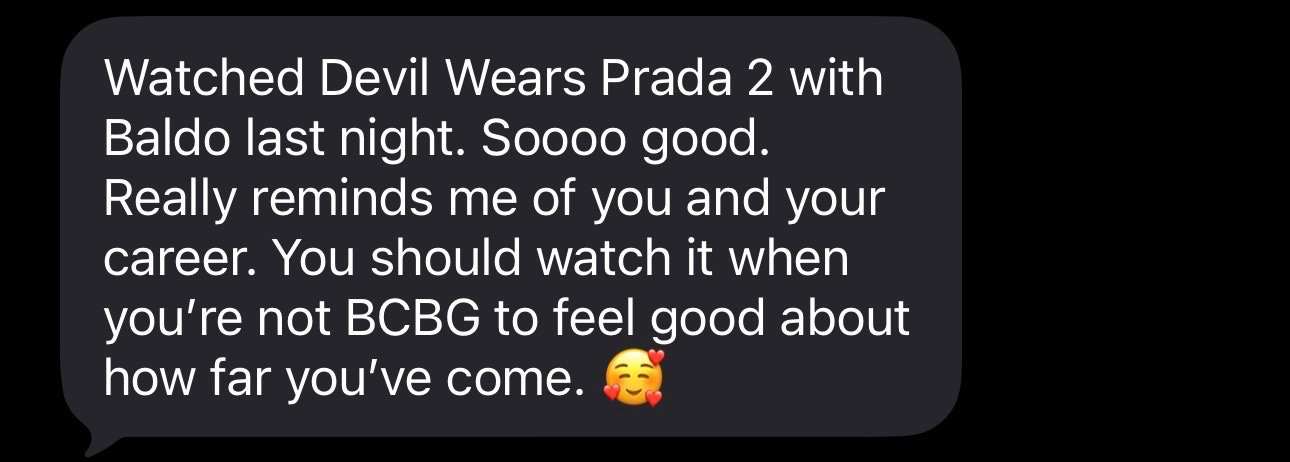
When I think back on everything I went through, all the layoffs, all the ghostwriting, all the contracts, all the bridges I burned that may or may not have lit my way, I can say this from my Upper East Side apartment with the clarity of someone who has survived enough corporate restructurings to qualify as a natural disaster:
I love the work.
It is so thrilling.
It is so much fun.
It is so much fun.
i was SAT for this review of a movie i haven’t seen. the work DOES matter, despite the job (or lack thereof).
Love your writing!